

The Supreme Court's Ruling Against White House Tariffs
On February 20th, the Supreme Court ruled that the Trump administration lacked the authority to impose the tariffs it enacted under the International Emergency Economic Powers Act (IEEPA). The ruling reaffirmed Congress’s central role in setting trade policy.
Following the ruling, the White House pivoted to Section 122 of the Trade Act of 1974, which allows the president to impose tariffs of up to 15% for 150 days without congressional approval. Tariffs of 10% under Section 122 went into effect on February 24. The administration is also pursuing other measures to support its trade policies, including Section 301 of the Trade Act of 1974 to address unfair trade practices and Section 232 of the Trade Expansion Act of 1962 for national security-based restrictions.
The chart below provides a quick re-cap of U.S. tariffs over the last 15 years:
Supreme Court Ruled Against White House Tariffs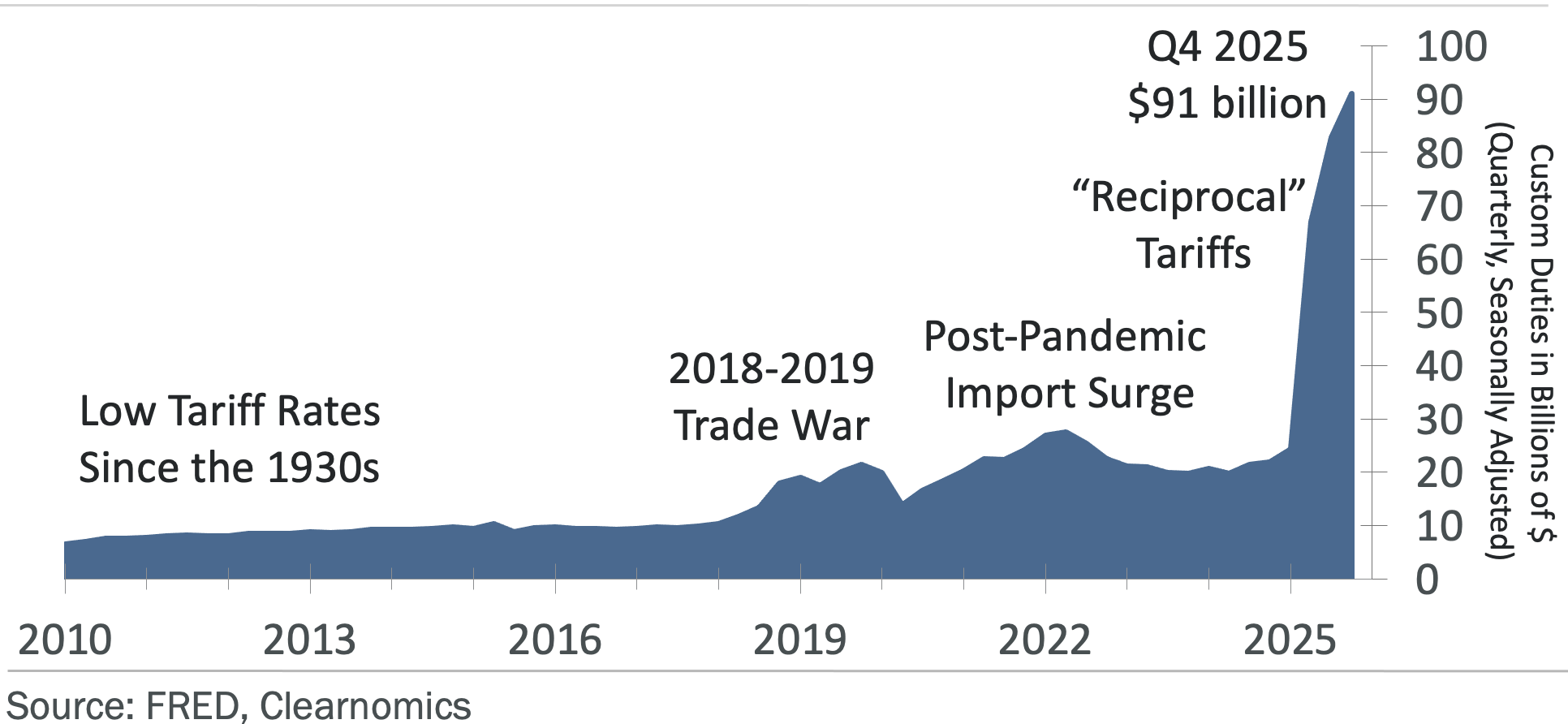
As illustrated above, U.S. customs duties or tariffs remained relatively subdued for much of the past decade, reflecting historically low tariff levels since the 1930s. Duties rose modestly during the 2018–2019 trade war with China and again during the post-pandemic import surge, but those increases were incremental compared to the spike in 2025. In the 4th quarter of 2025, tariffs surged to $91 billion, driven by the administration’s trade policy.
With the Supreme Court ruling, it must still be determined if businesses that paid tariffs under the IEEPA framework are entitled to refunds, and if individual Americans would be included in any reimbursements. The possibility of refunds represents a potential boost to corporate earnings, capital investment, and disposable income.
While the legal framework for tariffs has shifted, the broader policy direction remains intact. Trade uncertainty will likely continue to generate headlines and potential volatility in the months ahead. However, as history has shown, markets tend to adjust to new trade realities over time as companies adapt their supply chains and pricing strategies.
---
All content is for informational purposes only. It is not intended to provide any tax or legal advice or provide the basis for any financial decisions. Nor is it intended to be a projection of current or future performance or indication of future results. Past performance is no guarantee of future results. Purchases are subject to suitability. This requires a review of an investor’s objectives, risk tolerance, and time horizons. Investing always involves risk and possible loss of capital. Opinions expressed herein are solely those of Darrell Capital Management, LLC. The information has been derived from sources believed to be reliable but is not guaranteed as to the accuracy and completeness and does not purport to be a complete analysis of the materials discussed. All information and ideas should be discussed in detail with your financial, tax and legal advisors prior to implementation. The information contained herein should be in no way be construed or interpreted as a solicitation to sell or offer to sell advisory services to any residents of any state other than the State of California or where otherwise legally permitted. Advisory services are offered by Darrell Capital Management, LLC, an Investment Advisor in the State of California. Being registered as an investment advisor does not imply a certain level of skill or training. Social post reactions and comments should not be viewed as endorsements or testimonials.