

Oil Prices & Inflation Complicate the Fed's Next Move
Oil prices have been a major driver of inflation and interest rate expectations in 2026, as geopolitical tensions in the Middle East have disrupted global energy markets. However, after surging earlier in the year, oil prices retreated sharply during the second quarter. In this update, we examine the implications for inflation, the Federal Reserve's interest rate policy, and the broader economic outlook.
Oil Prices Return to Pre-Conflict Levels
As the conflict in Iran continues, the surge in oil prices has proven to be short-lived through the second quarter. Figure 1 tracks oil prices from 2021 through the end of the second quarter:
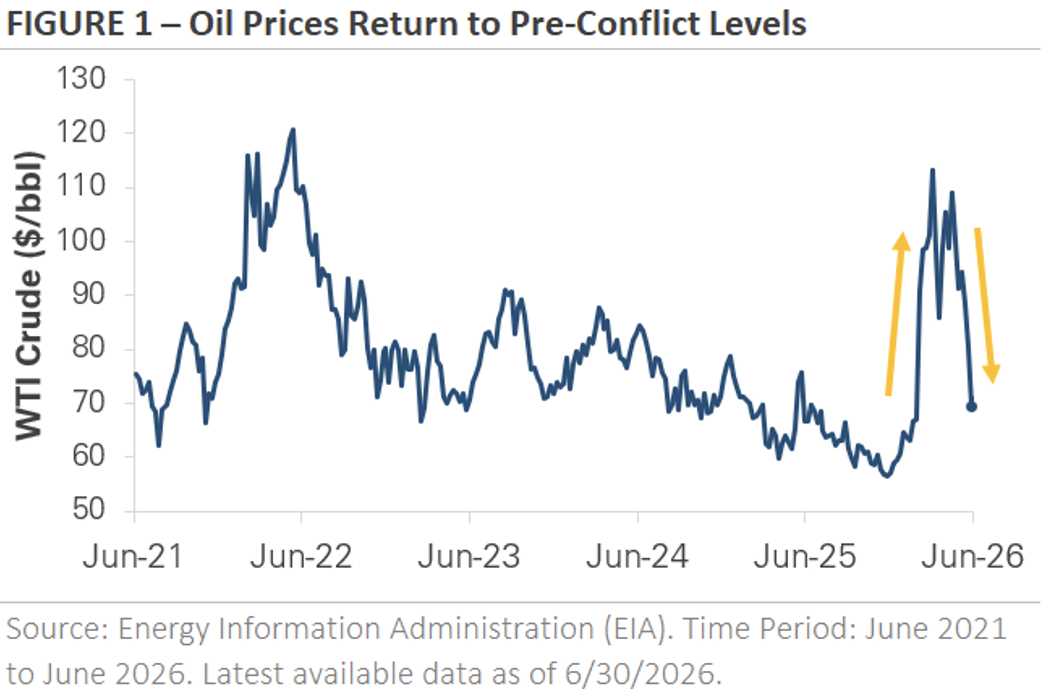
As illustrated by the yellow arrows, oil prices surged to a 2026 peak of $114.58 in April as the closure of the Strait of Hormuz disrupted global supply. Oil prices retreated from there, ending the quarter at $70.56 – near pre-conflict levels. For additional context, oil prices reached $123.64 in 2022 following the Russian invasion of Ukraine.
When oil prices spiked earlier this year, inflation followed. Consumer prices rose 4.2% year-over-year in May, the highest level in three years. Excluding food and energy, the underlying rate was +2.9% indicating the rise in inflation was driven by oil prices rather than broader price pressures.
Inflation Complicates the Fed’s Next Move
The Federal Reserve’s core mission, known as its “dual mandate,” is to promote maximum employment and stable prices. At the start of 2026, expectations were for the Fed to cut rates two to three times by year end to support the labor market and the economy.
Expectations shifted recently as inflation has remained above the Fed's target–largely due to the volatility of oil. While the Fed left short-term interest rates unchanged at their June meeting, concerns over persistent inflation indicate the Fed’s next move could be an interest rate hike.
Inflation readings are inherently backward-looking, so May’s data captured oil prices near their peak rather than where prices ended the quarter. With oil prices back at pre-conflict levels, the main driver of higher inflation has started to fade, and inflation could ease in the months ahead barring another supply shock.
Against this backdrop, the Federal Reserve also entered a period of leadership transition. Kevin Warsh was sworn in as the new Fed Chair in May, succeeding Jerome Powell. Warsh served on the Federal Reserve Board of Governors during the 2007 – 2009 financial crisis, when the Fed cut interest rates to near zero, launched several rounds of quantitative easing, and established emergency lending facilities. While he supported those measures during the crisis, he later expressed concerns about inflation risks and the longer-term implications of unconventional monetary policy.
Today, Warsh is widely viewed as favoring a leaner Fed balance sheet, taking a hawkish stance on inflation, and being skeptical of quantitative easing. Regardless of any institutional changes he may pursue, monetary policy is set by the twelve voting members of the Federal Open Market Committee. They continue to face a difficult balancing act: inflation remains above target while the labor market has shown mixed signals. Supporting employment would typically argue for lower interest rates, while addressing inflation could require tighter financial conditions.
History shows that the economy has grown under many different Federal Reserve chairs, regardless of political environment or policy approach. Earnings growth, productivity, demographics, and innovation remain important drivers of long-term investment returns.
-------
Advisory services are offered by Darrell Capital Management, LLC, an Investment Advisor in the States of California and Texas. All content is for informational purposes only. It is not intended to provide any tax or legal advice or provide the basis for any financial decisions. Nor is it intended to be a projection of current or future performance or indication of future results. Past performance is no guarantee of future results. Purchases are subject to suitability. This requires a review of an investor’s objectives, risk tolerance, and time horizons. Investing always involves risk and possible loss of capital. Opinions expressed herein are solely those of Darrell Capital Management, LLC. The information has been derived from sources believed to be reliable but is not guaranteed as to the accuracy and completeness and does not purport to be a complete analysis of the materials discussed. All information and ideas should be discussed in detail with your financial, tax and legal advisors prior to implementation. The information contained herein should be in no way be construed or interpreted as a solicitation to sell or offer to sell advisory services to any residents of any state other than the State of California or where otherwise legally permitted. Being registered as an investment advisor does not imply a certain level of skill or training. Social post reactions and comments should not be viewed as endorsements or testimonials.