


Navigating the Conflict in Iran
The situation in Iran remains fluid. The Strait of Hormuz is effectively closed to commercial traffic, the U.S. is maintaining its naval blockade, and negotiations appear to be at an impasse. While the human impact of the war continues to be significant, our role is to provide perspective on the potential financial market implications.
So far in April, oil prices (WTI) have traded between $84 and and $113 per barrel. At the same time, major U.S. equity indices — including the S&P 500, Dow Jones Industrial Average, and Nasdaq Composite — recently touched new record highs. Mixed signals underscore the complexity of the current geopolitical situation.
History suggests that while conflicts can introduce meaningful short-term volatility, markets have often demonstrated resilience over longer time horizons. The chart below offers perspective by illustrating market performance around several major geopolitical events over the past five decades:
Historical Market Impact of Regional Conflicts
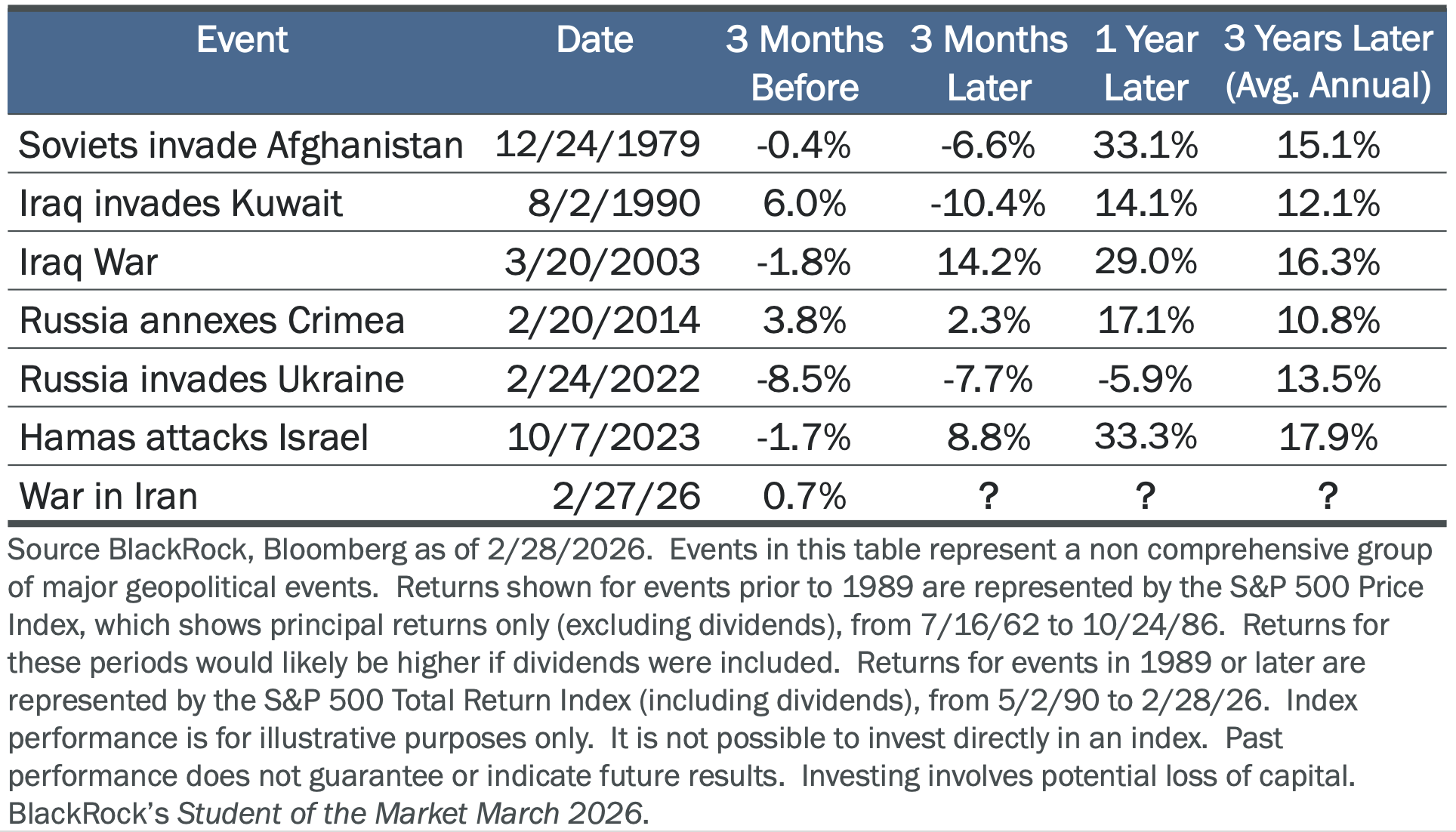
As illustrated above, the three-month period preceding regional conflicts typically captures escalating geopolitical uncertainty. Stock market performance during this window has historically been mixed with returns both positive and negative across events. Likewise, the three-month period following the start of conflicts has also been mixed for equity returns depending on the specific event. Returns one and three years later have generally been positive. The exception was the Russian invasion of Ukraine, which occurred during a broader bear market in 2022. Even in that case, the one-year return was only modestly negative, and the three-year average annual return was solidly positive.
While the final outcome remains uncertain, markets have historically absorbed geopolitical shocks over time as economic fundamentals reasserted themselves.
In the case of the current war in Iran, stocks were slightly positive in the three-month period leading up to U.S. military action (+0.7%). While the conflict has not reached its three-month mark, the S&P 500 declined nearly 8% from the start of the war to its low point on March 30. Even after that pullback, the S&P 500 and other major U.S. equity indices recently touched new all-time highs. While the scope of the conflict in Iran feels different from past events, the market’s reaction thus far has remained within historical ranges.
As geopolitical and economic conditions continue to evolve, we remain disciplined in our planning, thoughtful in our portfolio positioning, and focused on guiding our clients and their portfolios through these challenges and whatever lies ahead.
---
All content is for informational purposes only. It is not intended to provide any tax or legal advice or provide the basis for any financial decisions. Nor is it intended to be a projection of current or future performance or indication of future results. Past performance is no guarantee of future results. Purchases are subject to suitability. This requires a review of an investor’s objectives, risk tolerance, and time horizons. Investing always involves risk and possible loss of capital. Opinions expressed herein are solely those of Darrell Capital Management, LLC. The information has been derived from sources believed to be reliable but is not guaranteed as to the accuracy and completeness and does not purport to be a complete analysis of the materials discussed. All information and ideas should be discussed in detail with your financial, tax and legal advisors prior to implementation. The information contained herein should be in no way be construed or interpreted as a solicitation to sell or offer to sell advisory services to any residents of any state other than the State of California or where otherwise legally permitted. Advisory services are offered by Darrell Capital Management, LLC, an Investment Advisor in the State of California. Being registered as an investment advisor does not imply a certain level of skill or training. Social post reactions and comments should not be viewed as endorsements or testimonials.