


Market Perspectives on Recent Middle East Developments
As you have seen in the news over the last few days, the U.S. and Israel continue to carry out coordinated strikes in Iran — including against its leadership, military facilities, and nuclear infrastructure. In response, Iran and its allies have launched missiles and drones targeting U.S. forces and several countries across the Middle East.
The situation continues to evolve, and the safety of civilians in the region and U.S. service members is foremost in our hearts and minds. While the human impact is heartbreaking, our role is to provide perspective on the potential financial market implications — including what this may mean for markets, oil prices, and your portfolio.
Thus far the impact on stock and bond prices has been relatively muted, while the price of oil has jumped. Uncertainty around the duration and scope of the conflict has the potential to create volatility in the markets over the coming days and weeks.
While the scale of the current strikes is significant, tensions have been escalating in recent months, marked by a U.S. military buildup in the region, stalled nuclear negotiations, and confrontations stretching back years:
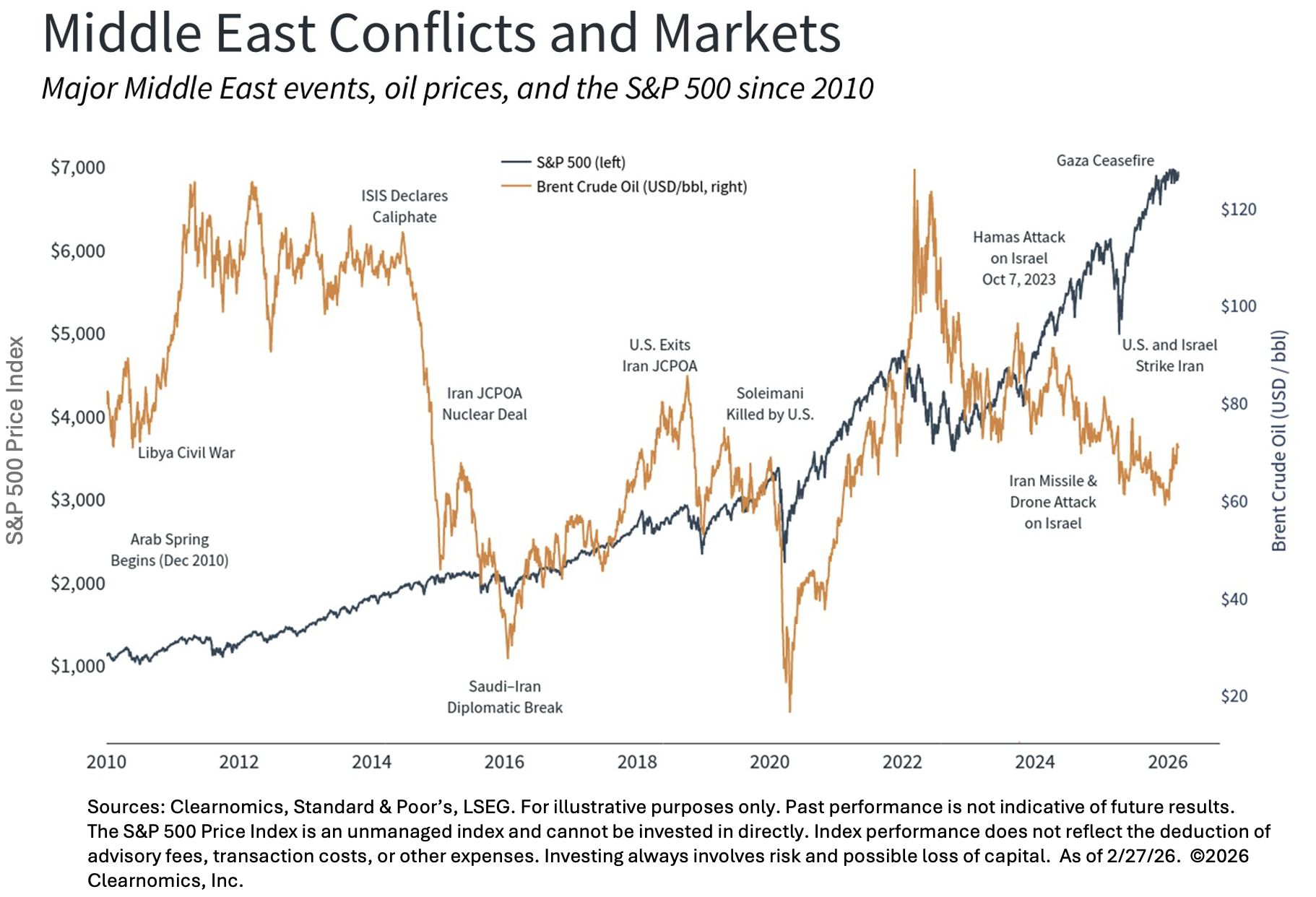
This chart shows major Middle East geopolitical events since 2010 alongside Brent crude oil prices (orange line) and the S&P 500 (blue line, price change). While oil prices have often reacted sharply to regional conflicts, equity markets have historically proven resilient.
In most cases, oil price spikes were temporary and the S&P 500 continued its longer-term upward trajectory despite short-term volatility. While geopolitical events can create short-term market swings, equities have historically demonstrated resilience over time.
The Strait of Hormuz & Oil Prices
Iran sits along the Strait of Hormuz. Approximately one-third of all seaborne oil exports pass through this waterway making it a natural flashpoint. A key question is whether Iran has the means and willingness to cause long-lasting disruption within this strait.
Even with the recent increase, oil prices remain well below the March 2022 peak of nearly $128 per barrel triggered by Russia’s invasion of Ukraine. After reaching that peak, oil prices fell back to the low $80s by the end of the year.
The U.S. is structurally far less vulnerable to energy shocks than it was in the 1970s or early 2000s. In 2018, the United States became the world’s largest producer of oil and natural gas:
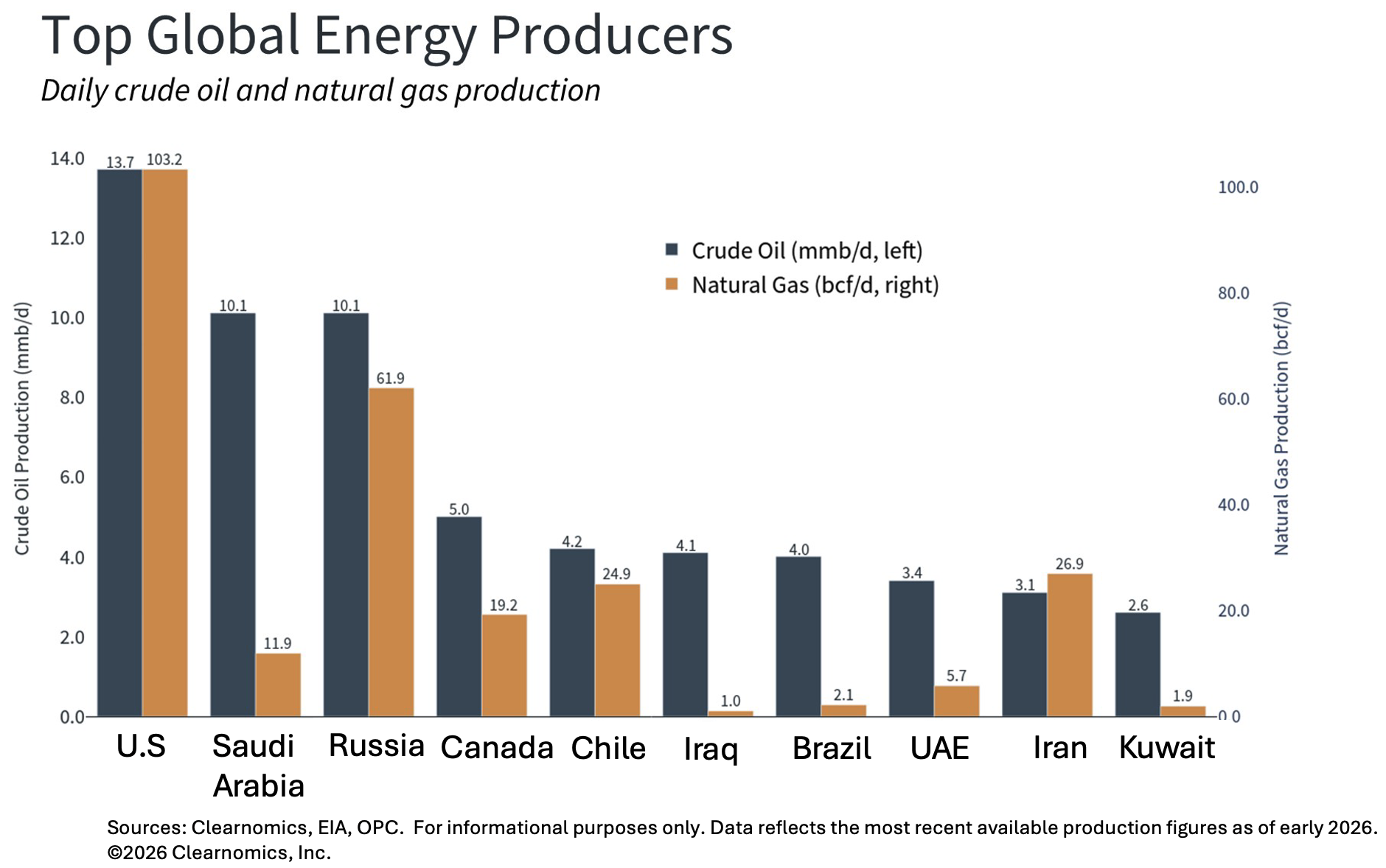
As illustrated in the chart above, the U.S. is the world’s largest producer of crude oil and natural gas. The United States produces roughly 13.7 million barrels of oil per day and over 100 billion cubic feet of natural gas daily. Saudi Arabia and Russia follow in oil production, each producing about 10 million barrels per day, although Russia produces significantly more natural gas than Saudi Arabia. Iraq, the United Arab Emirates, Iran, and Kuwait round out the list of major oil producers.
The global energy supply is now more geographically diversified than it’s ever been, with the U.S. as the dominant producer. While disruptions in the Middle East can influence oil prices in the short term, the broader global production base helps cushion longer-term supply shocks. While the U.S. still participates in global energy markets, its production levels help insulate the domestic economy from supply disruptions.
We continue to monitor the geopolitical situation, its investment implications, and portfolios closely.
---
All content is for informational purposes only. It is not intended to provide any tax or legal advice or provide the basis for any financial decisions. Nor is it intended to be a projection of current or future performance or indication of future results. Past performance is no guarantee of future results. Purchases are subject to suitability. This requires a review of an investor’s objectives, risk tolerance, and time horizons. Investing always involves risk and possible loss of capital. Opinions expressed herein are solely those of Darrell Capital Management, LLC. The information has been derived from sources believed to be reliable but is not guaranteed as to the accuracy and completeness and does not purport to be a complete analysis of the materials discussed. All information and ideas should be discussed in detail with your financial, tax and legal advisors prior to implementation. The information contained herein should be in no way be construed or interpreted as a solicitation to sell or offer to sell advisory services to any residents of any state other than the State of California or where otherwise legally permitted. Advisory services are offered by Darrell Capital Management, LLC, an Investment Advisor in the State of California. Being registered as an investment advisor does not imply a certain level of skill or training. Social post reactions and comments should not be viewed as endorsements or testimonials.