

Federal Reserve Leadership & U.S. Economic Growth
As reported in recent headlines, President Trump nominated Kevin Warsh to serve as the next Chair of the Federal Reserve. Warsh previously served on the Federal Reserve Board of Governors from 2006 to 2011. Pending Senate confirmation, he is expected to succeed Jerome Powell, whose term is up in May. Powell has served as Fed Chair since February 2018.
Warsh served on the Federal Reserve Board of Governors during the global financial crisis (2007-2009), a period marked by extraordinary measures. In response to the crisis, the Fed cut its policy rate to near zero, launched multiple rounds of quantitative easing, and established emergency lending facilities to stabilize financial markets. As a Fed Governor, Warsh participated in these crisis-era decisions. In the years that followed, he expressed concerns about inflation risks and the longer-term implications of unconventional monetary policy.
Warsh is widely viewed as favoring a leaner Fed balance sheet, taking a hawkish stance on inflation, and being skeptical of quantitative easing. While his views may not always align with the administration’s monetary policy preferences, he is often described as pragmatic in navigating policy and communications.
In the very short term, the announcement coincided with a modest strengthening of the U.S. dollar and declines in gold and silver—both of which had rallied amid heightened geopolitical risks, central bank purchases, and concerns over Federal Reserve independence. Warsh’s nomination may have eased some of these concerns.
While the Fed Chair leads the Board of Governors, monetary policy is set by the Federal Open Market Committee (FOMC), which has twelve voting members and reflects a range of perspectives. The committee includes the President of the New York Fed, seven Fed Governors, and four regional Reserve Bank presidents, who rotate annually. Historically, the FOMC has generally worked toward consensus in setting monetary policy.
The chart below illustrates how the U.S. economy has grown under past and present Fed Chairs:
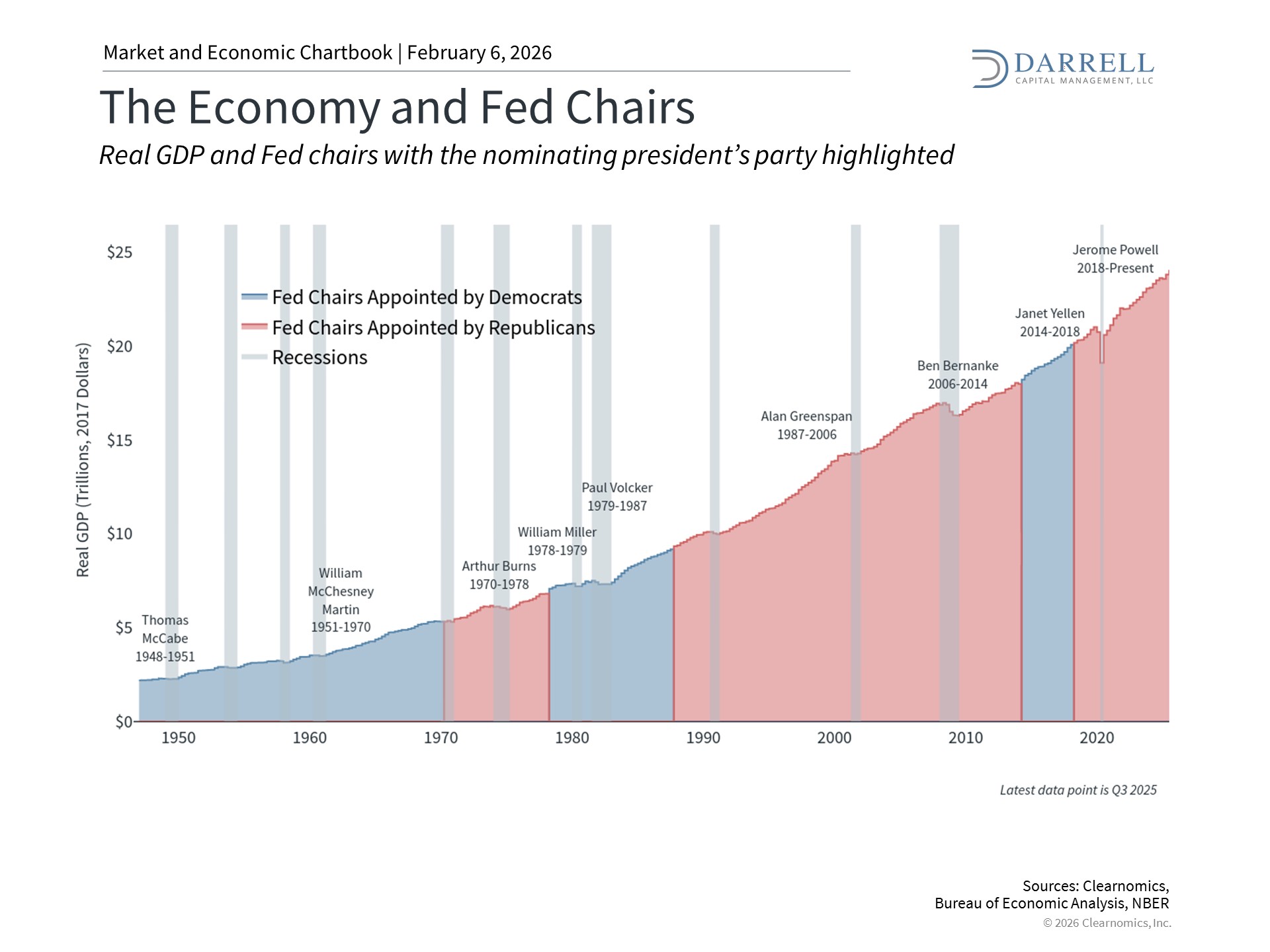
The chart shows real GDP growth since 1948, with each Federal Reserve Chair labeled according to the years of their tenure. Chairs nominated by Republican presidents are shown in red, while those nominated by Democratic presidents are shown in blue. Over time, the Fed has experienced numerous leadership transitions, and real GDP has increased under Chairs appointed by both political parties.
While the Federal Reserve’s leadership periodically changes, its dual mandate—maximum employment and price stability—remains central to key monetary policy decisions.
-------------------
All content is for informational purposes only. It is not intended to provide any tax or legal advice or provide the basis for any financial decisions. Nor is it intended to be a projection of current or future performance or indication of future results. Past performance is no guarantee of future results. Purchases are subject to suitability. This requires a review of an investor’s objectives, risk tolerance, and time horizons. Investing always involves risk and possible loss of capital. Opinions expressed herein are solely those of Darrell Capital Management, LLC. The information has been derived from sources believed to be reliable but is not guaranteed as to the accuracy and completeness and does not purport to be a complete analysis of the materials discussed. All information and ideas should be discussed in detail with your financial, tax and legal advisors prior to implementation. The information contained herein should be in no way be construed or interpreted as a solicitation to sell or offer to sell advisory services to any residents of any state other than the State of California or where otherwise legally permitted. Advisory services are offered by Darrell Capital Management, LLC, an Investment Advisor in the State of California. Being registered as an investment advisor does not imply a certain level of skill or training. Social post reactions and comments should not be viewed as endorsements or testimonials.