

AI Spending & Market Breadth Expand
Investment in artificial intelligence continues to accelerate, with major technology companies committing substantial capital to building the infrastructure needed to support its growth. While AI remains a dominant market theme, stock market gains have broadened beyond technology, with smaller companies benefiting from improving profitability and resilient economic conditions. In this review, we examine these developments and their implications for the broader stock market.
AI Spending Continues to Grow
The data suggest businesses continue to invest heavily in artificial intelligence (AI) as they integrate the technology into products, operations and business processes. The following chart details the combined capital spending of five of the largest tech companies focused on AI infrastructure: Microsoft, Amazon, Meta, Alphabet and Oracle:
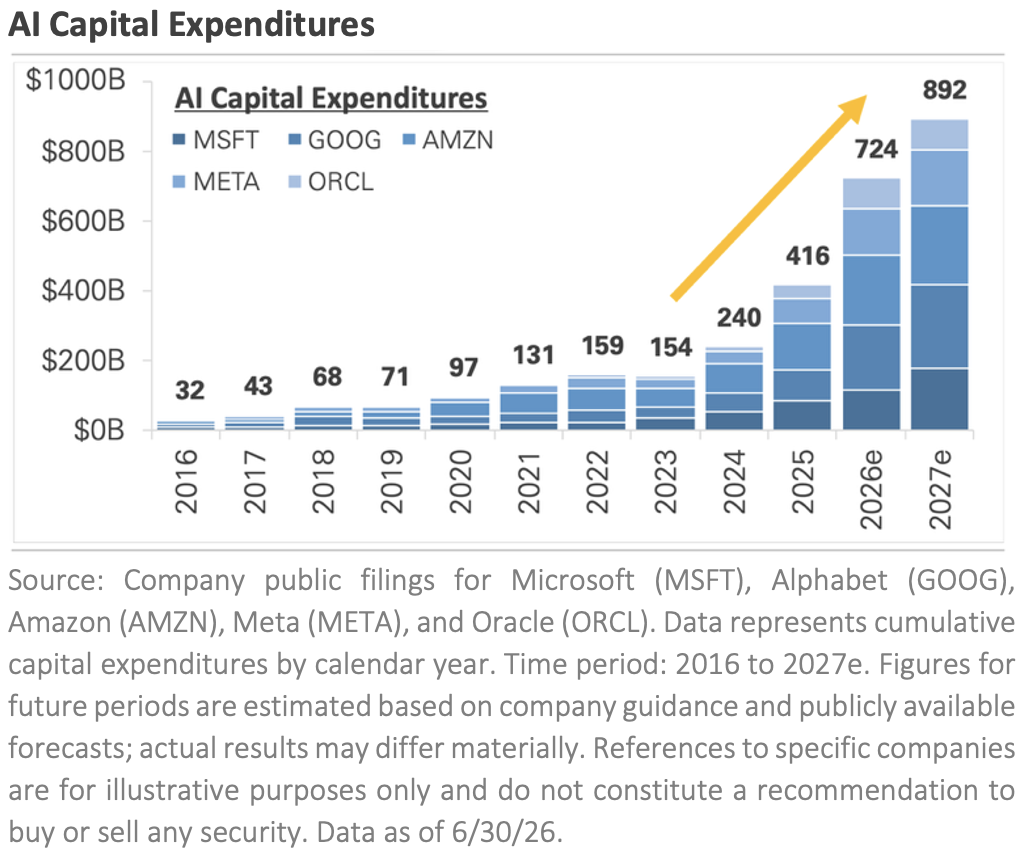
In 2016, this group of companies spent a combined $32 billion. By 2025, that figure grew to $416 billion. These five companies are projected to spend about $724 billion in 2026 and nearly $900 billion in 2027. The spending is slated to go towards data centers, computer chips, and the equipment and power to utilize them.
Many other businesses are following suit. High profile private companies are filing for IPOs to raise capital for the tech build-out, while already public companies are turning to the debt and equity markets to finance spending. SpaceX completed the largest IPO in history, raising $86 billion. OpenAI and Anthropic, are expected to follow over the next year. Companies such as Alphabet and Oracle have recently raised capital in the public markets to help finance investments in AI infrastructure and cloud computing.
Market Breadth Expands Beyond Technology
Stock performance has been strong. The graph below compares return across several indexes through the end of the second quarter:
Total Returns for the First Half of 2026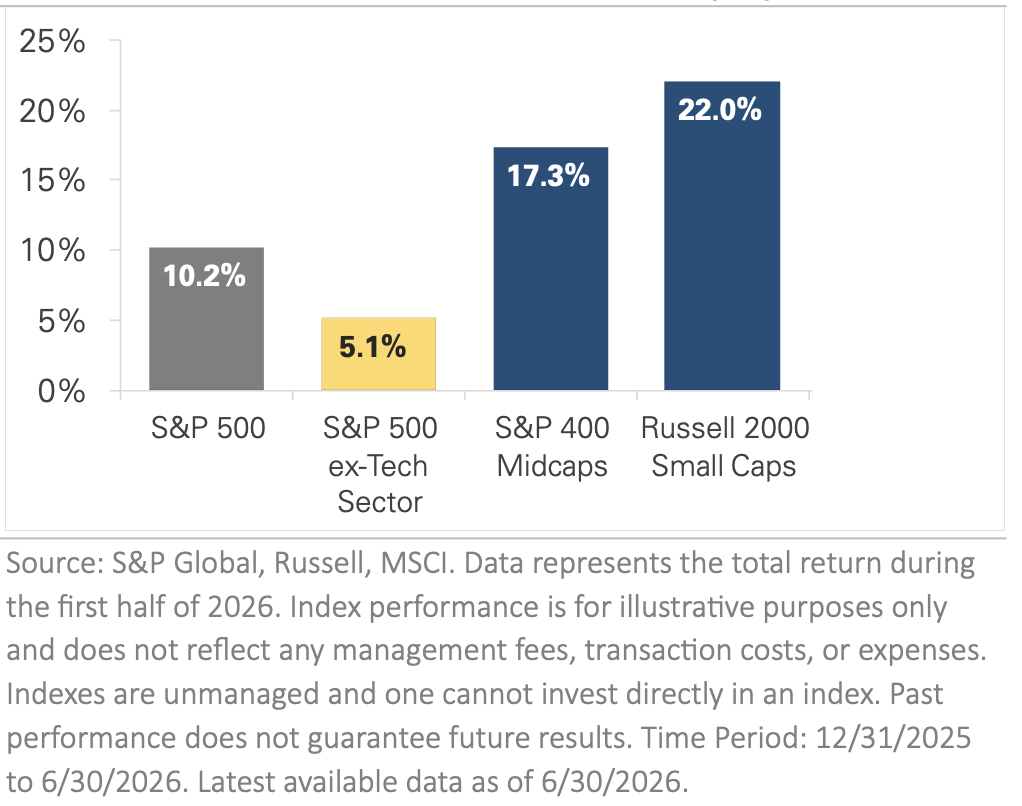
This balance is rooted in the recent profitability of smaller companies, the overall economy, and company valuations. Higher interest rates in 2022 and 2023 increased borrowing costs and pressured profit margins for many smaller companies as the Federal Reserve raised rates to counter inflation. As interest rates began to decline in 2024, financing conditions gradually improved, helping support corporate profitability and easing cost pressures.
Additionally, smaller companies tend to be more sensitive to economic conditions, so the resilience of the U.S. economy has provided a favorable backdrop for earnings growth. This year’s surge in oil prices has weighed less on the economy than past crises because today's economy depends far less on oil than it did in the 1970s.
Finally, after years of tech stocks leading the market, smaller companies appear more attractively valued by comparison. Improving earnings have helped narrow the gap between their fundamentals and market valuations.
Broader Market Participation
While artificial intelligence continues to attract substantial investment and influence financial markets, the broadening of stock market gains beyond technology is an encouraging development. Improving corporate profitability and resilient economic growth have helped support a wider range of companies. As these trends evolve, maintaining a diversified portfolio remains important, particularly given the uncertainty surrounding which companies and sectors will ultimately benefit most from the AI investment cycle.
-------
Advisory services are offered by Darrell Capital Management, LLC, an Investment Advisor in the States of California and Texas. All content is for informational purposes only. It is not intended to provide any tax or legal advice or provide the basis for any financial decisions. Nor is it intended to be a projection of current or future performance or indication of future results. Past performance is no guarantee of future results. Purchases are subject to suitability. This requires a review of an investor’s objectives, risk tolerance, and time horizons. Investing always involves risk and possible loss of capital. Opinions expressed herein are solely those of Darrell Capital Management, LLC. The information has been derived from sources believed to be reliable but is not guaranteed as to the accuracy and completeness and does not purport to be a complete analysis of the materials discussed. All information and ideas should be discussed in detail with your financial, tax and legal advisors prior to implementation. The information contained herein should be in no way be construed or interpreted as a solicitation to sell or offer to sell advisory services to any residents of any state other than the State of California or where otherwise legally permitted. Being registered as an investment advisor does not imply a certain level of skill or training. Social post reactions and comments should not be viewed as endorsements or testimonials.